At a glance
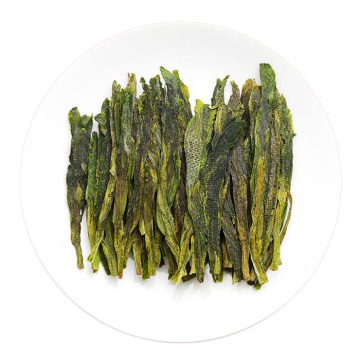
Taiping Houkui is a green tea from the Huangshan area of Anhui, recognisable for its unusually long, flattened leaves. Its size is part of this tea’s style: do not judge it by the small-bud appearance of a different green tea. A clear, heat-safe glass gives the leaves room to open.
| Detail | What to know |
|---|---|
| Chinese name | 太平猴魁 |
| Tea family | Green tea |
| Associated origin | Huangshan district, Anhui |
| Leaf form | Long, flattened buds and leaves |
Taste and appearance
The inherited comparison describes a fresh, full cup, a sweet finish and, in its top tier, an orchid-like aroma. Its traditional shape saying describes pointed ends with leaves lying flat rather than curling. These are sensory descriptions, not a promise that every packet will taste identical. Orchid notes do not establish added flowers.
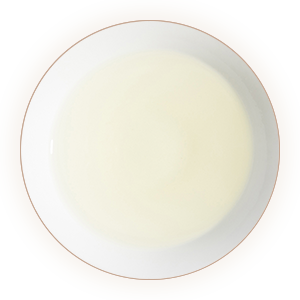
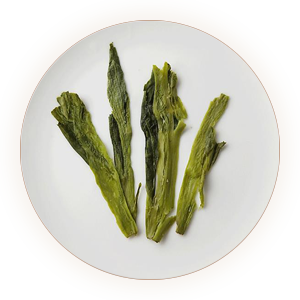
The dry-leaf illustration appears as the cover above. Original pictures are reference illustrations, not proof of origin, grade, authenticity or image rights clearance.
Grade characteristics
This preserves the earlier Chinese edition’s sensory comparison. It is not a complete verified current standard table, and does not grade your packet. Ask which grading system and product style the seller uses. Decorative star rankings are omitted.
On a small screen, scroll the table sideways to compare the grades.
| Feature | Extra grade | Grade 1 | Grade 2 |
|---|---|---|---|
| Dry-leaf shape | Flat and substantial, two leaves enclosing a bud, hairs not prominent, some dark-red main veins, even | Flat and thick, two leaves enclosing a bud, hairs inconspicuous, some dark-red main veins, fairly even | Flat, two leaves enclosing a bud, a few separate leaves, hairs inconspicuous, reasonably even |
| Dry-leaf colour | Deep fresh green and bright | Deep green, fairly even and lustrous | Lustrous green |
| Liquor | Tender green and bright | Pale yellow-green and bright | Yellow-green and bright |
| Aroma | Fresh and high, with an orchid-like note | Clear and high | Reasonably clear and high |
| Taste | Fresh, full and brisk, sweet finish; traditional Houyun character | Fresh and brisk, returning sweetness | Full and sweet |
| Infused leaves | Tender, even and thick, opened bud-and-leaf sets, bright pale yellow-green | Tender, even opened sets, bright yellow-green | Reasonably tender opened sets, a few separate leaves, bright yellow-green |
Houyun is a traditional tasting term rather than a measured ingredient. An obvious transcription error in the old top-tier shape row is read only as hairs not prominent; it is not evidence for a numerical hair standard.
Names and origin
The earlier entry places the tea around Xinming in Huangshan district, formerly Taiping county, and names Houkeng, Hougang and Yanjia around Sanmen. Those locality names are useful questions for a seller, not a ranking that makes one village automatically best. The wider term Taiping Jiancha and the labels Houjian and Jiancha in older accounts should not be treated as three current official grades of Houkui.
Everyday benefits
Brewed without added sugar, this is an ordinary tea drink that can be an alternative to sweetened drinks and contribute to fluid intake. It contains caffeine. These everyday properties do not establish that this named tea treats disease, lowers blood sugar or improves sleep. No TeaPlain clinical or brewing test is claimed here.
Who may enjoy this tea
You may enjoy it if you like watching large leaves unfold or want to compare flattened green tea with curled Biluochun. Choose a glass or infuser with space for the leaves instead of forcing them into a tiny tea ball.
When to take care
- Caffeine sensitivity or sleep problems: consider your total intake and timing if tea affects your sleep. A pale infusion is not a caffeine-free claim.
- Pregnancy, breastfeeding or medicines: ask a clinician or pharmacist about your actual product, caffeine intake and relevant medicine instructions.
- Iron supplements: follow the medicine’s instructions about separating tea from the dose. Do not use tea as treatment for anaemia.
These are product and individual considerations, not a blanket ban based on traditional “hot” or “cold” labels, age, sex or a constitution category.
How to brew
Original Chinese glass method
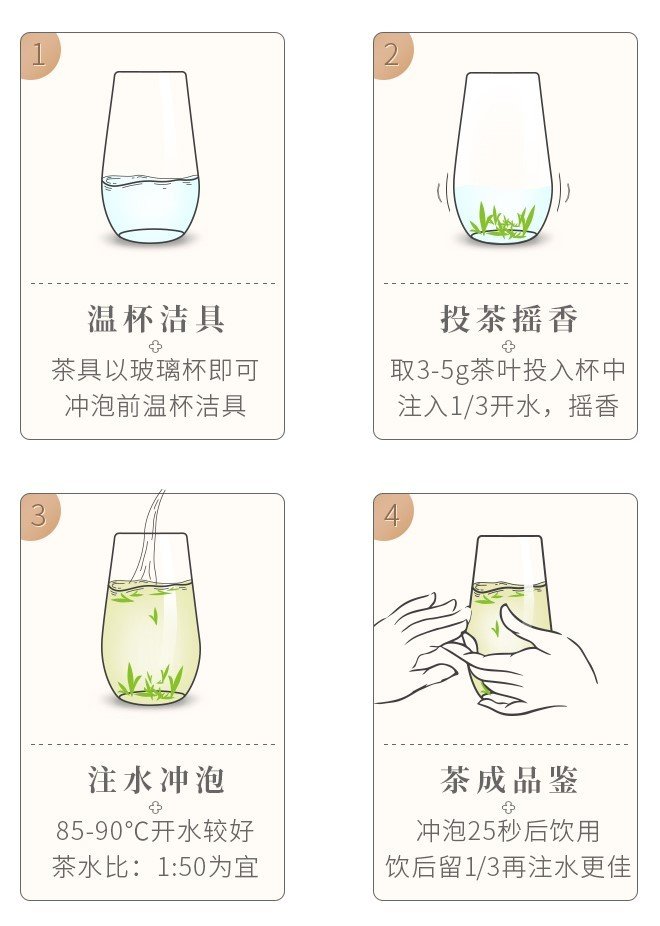
The original diagram gives 3–5 g and a 1:50 tea-to-water ratio. Its 25-second checkpoint is unusually short for a glass method: treat it as an initial taste, then adjust rather than replacing it silently with a different recipe. The original prose retains the same ratio and temperature but gives no first-steep time.
| Detail | Pictured method and explicit conditions |
|---|---|
| Tea | 3 g as an editorial example within the diagram’s 3–5 g range |
| Actual water | 150 mL / about 5.1 US fl oz, measured; calculated from 3 g at 1:50 |
| Vessel | Heat-safe glass with spare room for leaves and headroom; nominal capacity is not measured water |
| Water temperature | 85–90°C / 185–194°F |
| First taste | The diagram gives a 25-second first taste, not a long mug steep |
| Preliminary water | Preheat the empty glass and discard that water; no separate leaf rinse is specified |
| Leaves | Remain in the glass; separate the liquid if leaving it standing |
The measured water refers to the drinking infusion; any discarded preheating or rinse water is separate. Use the packet’s complete method first. These retained recipes and editorial ratio examples are awaiting hands-on testing. Neither a rinse nor a brief wait is a validated disinfection step. Let the drink cool enough for you to sip; steeping time is not a measured safe drinking temperature.
Refill towards the original level when about one-third remains, as in the earlier entry. Its reference to roughly three infusions is an example, not a guarantee of equal strength. If using an infuser, follow a separate complete mug or pot method rather than transferring a short glass checkpoint to a new leaf-to-water ratio.
Adjust your cup
| What you notice | One change to try |
|---|---|
| Too strong, bitter or drying | Separate the liquid from the leaves; shorten contact time or use less tea next time |
| Weak or watery | Keep the measured water fixed and try a longer infusion before changing the leaf dose |
| Later infusions become stronger | Check whether liquid was left sitting with the leaves |
| Different from a flavour description | Compare the actual product and method; a description is not a promise for every cup |
Change one variable at a time. For a fuller sequence, see fix a disappointing first cup.
How to buy
Ask for the growing area, harvest information and producer, and inspect how the long leaves have survived packing and shipping. Compare the same style and weight. Large leaves are not by themselves a low-grade sign, and a grid mark or a photograph cannot certify a particular village or hand-processing claim.
For a practical checklist, read buy your first Chinese tea.
China price reference
Undated figures retained from the Chinese edition, in Chinese yuan (CNY). No brand, production batch or quotation date was recorded. These are not verified current retail quotes, a market average or manufacturer-suggested retail prices.
| Chinese-edition tier | CNY per 500 g (one jin) | Equivalent CNY per 100 g |
|---|---|---|
| Legacy premium label | 4,000 | 800 |
| Extra grade | 1,500 | 300 |
| Grade 1 | 800 | 160 |
| Grade 2 | 500 | 100 |
| Grade 3 | 400 | 80 |
The 100 g column is an arithmetic unit conversion, not a quoted packet. Legacy premium labels in a price list do not create extra verified official grades. Compare actual origin, harvest, weight and sales channel. UK and US prices may include shipping, import and local retail costs; converting currency does not make two products comparable.
How to store
Original storage method
The Chinese edition describes sealing green tea in a foil pouch, gently removing excess air and closing it before placing it inside a lidded tin. For cold storage, keep the moisture-resistant inner packaging sealed. It suggested taking out a one-to-two-week working portion for green tea rather than repeatedly opening the main cold supply; that portion size is a practical option, not a shelf-life measurement.
Its historical targets were below 10°C / 50°F and below 50% relative humidity, with a 12-month general shelf-life reference. These are retained as legacy figures, not a newly verified expiry date for your packet. The old text also allowed a cool room-temperature location for tea expected to be used within about two months. The actual product’s label and packaging conditions take precedence.
In a UK or US kitchen
Use the producer’s instructions to decide whether refrigeration is appropriate. A closed outer tin is not a substitute for a sealed moisture-resistant pouch. If a sealed packet has been chilled, let it warm while still sealed before opening. Keep a daily portion away from the hob or stove, dishwasher steam and spice containers. Do not store it in an open paper bag beside food smells. See storing an opened packet for handling conditions.
Origin, processing and history
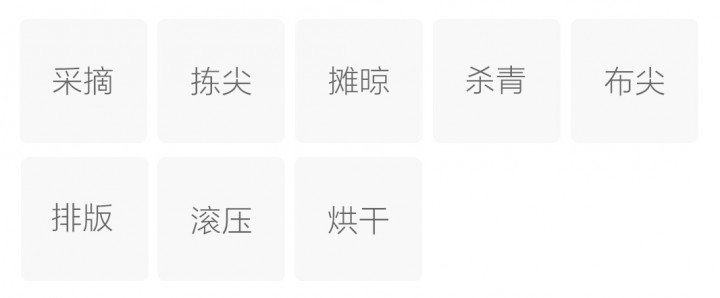
Traditional manufacture combines picking, sorting the shoots, spreading, early heating, flattening/shaping and drying. The retained graphic adds the cloth, board arrangement and pressing stages to show how its flat form is made. The late-Qing origin account belongs to the tea’s history; it does not date your packet or establish its grade.
Common questions
Do bigger leaves mean this is low-grade tea?
No size rule transfers reliably from another tea. Taiping Houkui has a distinctive large, flat form. Compare like-for-like style, condition, origin information and the seller’s stated grade system.
Must I break the leaves to fit a small infuser?
Use a vessel with enough room for the long leaves where possible. The glass method here leaves them loose; if you prefer tea-water separation, use a roomy basket and the linked mug guide rather than treating a tiny tea ball as the same method.
Compare another tea: Biluochun.
Editorial notes and updates
Updated 16 October 2026. This English adaptation retains useful original descriptions, sensory comparisons, recipe variants, storage handling and undated China prices. Doubtful identity and health claims are revised or omitted. Exact current grade clauses and historical prices are not certified; diagrams remain Chinese-labelled with English explanations. Pictures are inherited illustrations, not TeaPlain samples. Research and image decisions are recorded internally; no tasting or brewing test is claimed.