At a glance
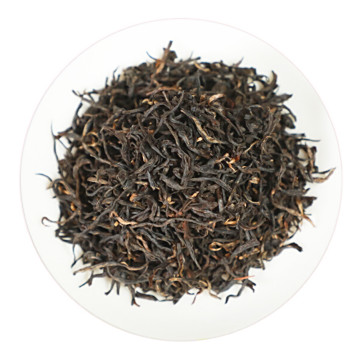
Yuehong Gongfu is a Zhejiang gongfu black-tea name, with the Shaoxing area central to the inherited account. It is recognised for fine, straight, carefully worked strands and a clean, mellow cup. Regional history, a brand’s trade usage and a current packet’s actual growing locality need to be read separately.
| Detail | What to know |
|---|---|
| Chinese name | 越红工夫茶 |
| Tea family | Black tea |
| Associated origin | Shaoxing area, including Zhuji and Shengzhou, Zhejiang |
| Leaf form | Fine, tight, straight, even strands with pointed tips |
Taste and appearance
The original profile describes fine, tight, straight strands, pointed tips and lustrous dark leaf, with comparatively light red liquor, a high clean aroma and a mellow sweet taste. The prose describes a copper-toned infused leaf while the comparison table says somewhat dark; these descriptions are preserved without making one mandatory colour test for authenticity.
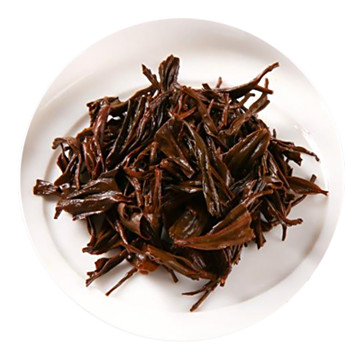
The original liquor photograph is withheld because identical pixels were assigned to another tea name. Its named identity could not be confirmed; the original file is preserved.
The cover is the original dry-leaf illustration. These images are not TeaPlain tasting samples or proof of origin, grade, age, authenticity or image rights clearance.
Grade characteristics
This preserves the earlier Chinese edition’s sensory comparison. It is not a complete verified current standard table and does not grade your packet. Plant material, growing area, processing and grade are separate details. Decorative star rankings are omitted.
On a small screen, scroll the table sideways to compare the grades.
| Feature | Extra grade | Grade 1 | Grade 2 |
|---|---|---|---|
| Dry-leaf shape | Fine, tight, straight and even, clear pointed tips | Fine, tight, straight and even, reasonably visible pointed tips | Fine and tight, reasonably straight, some pointed tips |
| Dry-leaf colour | Lustrous dark leaf | Lustrous dark leaf | Lustrous dark leaf |
| Liquor | Comparatively light red and bright | Red, reasonably bright | Red, reasonably bright |
| Aroma | High, clean and lasting | Clean and high | Clean |
| Taste | Mellow and sweet | Reasonably mellow and sweet | Mellow with slight sweetness |
| Infused leaves | Even, somewhat dark | Reasonably even, somewhat dark | Fairly even, somewhat dark |
The older three-tier sensory table is retained without turning a heritage listing into grade certification. Historical alternative names Tiaohong and Zhemaohong remain searchable, not mandatory modern package names.
Names and origin
The old entry names Zhuji, Keqiao and Shengzhou in the Shaoxing area; Shengxian is older wording for the Shengzhou area. Its 1955 naming date is retained as the earlier source’s historical account rather than a newly certified universal invention date. Yue is the regional historical name context. Public local records list Yuehong tea-making at Zhuji city level in June 2016 and Shaoxing city level in March 2020; these are different listings, not national status or a certificate for every product.
Everyday benefits
Brewed without added sugar, this is an ordinary tea drink that can be an alternative to sweetened drinks and contribute to fluid intake. It contains caffeine. These everyday properties do not establish that this named tea treats disease, lowers blood sugar or improves sleep. No TeaPlain clinical or brewing test is claimed here.
Who may enjoy this tea
Try an identified product if you like a clean, fine-strand black tea with a mellow sweet cup. A lighter red colour is a sensory description, not evidence of low caffeine or a reason to add more tea automatically.
When to take care
- Caffeine sensitivity or sleep problems: consider your total intake and timing if tea affects your sleep. A pale infusion is not a caffeine-free claim.
- Pregnancy, breastfeeding or medicines: ask a clinician or pharmacist about your actual product, caffeine intake and relevant medicine instructions.
- Iron supplements: follow the medicine’s instructions about separating tea from the dose. Do not use tea as treatment for anaemia.
These are product and individual considerations, not a blanket ban based on traditional “hot” or “cold” labels, age, sex or a constitution category.
How to brew
Original prose: short gaiwan infusions
The earlier Chinese prose gives a white porcelain gaiwan, 1:20 tea-to-water ratio, 95–100°C / 203–212°F water and a 5-second pour after adding water. It does not specify a tea dose. The example below makes the ratio explicit; its amounts are an editorial illustration of the prose, not measurements inferred from the separate graphic.
| Detail | Original prose with an explicit ratio example |
|---|---|
| Tea | 5 g loose Yuehong Gongfu as an editorial example |
| Actual water | 100 mL / about 3.4 US fl oz, measured; 5 g at 1:20 |
| Vessel | Heat-safe porcelain gaiwan with room for the measured water and leaves |
| Water temperature | 95–100°C / 203–212°F |
| First infusion | 5 seconds, then decant completely; account for filling and pouring time |
| Leaves | Kept separate from the liquid after each pour |
Use your packet’s complete directions first. These inherited methods and editorial examples are awaiting hands-on testing. The earlier five-to-seven-infusion statement is not a guarantee of equal-strength cups. The prose does not specify a leaf rinse; any rinse shown in the separate image is not added silently to this version and is not a validated disinfection step. Let the drink cool enough to sip.
Read the original illustration separately
The shared original image gives 5 g in a nominal 110 mL gaiwan with 95–100°C / 203–212°F water. It describes about 5 seconds for each of the first three drinking infusions, then longer waits. Actual water after leaf displacement is not measured. Its preheating step is not a validated disinfection process and the spring photograph does not establish potable water. The source prose’s separate 1:20 example stays separate.
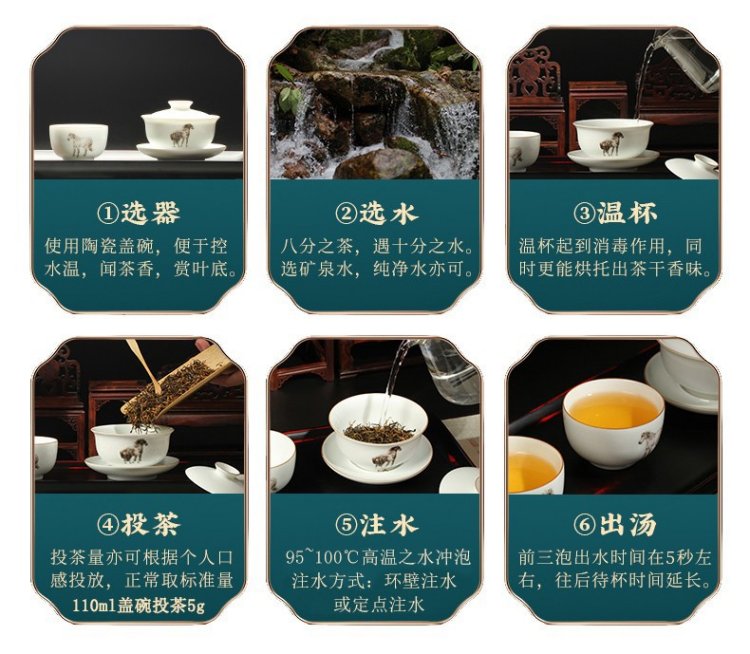
For ordinary teaware options, see brew without a gaiwan. Keep each complete method together instead of selecting temperature, dose and time from different preparations.
Adjust your cup
| What you notice | One change to try |
|---|---|
| Too strong, bitter or drying | Separate the liquid from the leaves; shorten contact time or use less tea next time |
| Weak or watery | Keep the measured water fixed and try a longer infusion before changing the leaf dose |
| Later infusions become stronger | Check whether liquid was left sitting with the leaves |
| Different from a flavour description | Compare the actual product and method; a description is not a promise for every cup |
Change one variable at a time. For a fuller sequence, see fix a disappointing first cup.
How to buy
Ask for the actual growing locality, harvest, maker and grade. The wider Zhejiang Congou trade uses Yuehong wording, while this page preserves the Shaoxing-focused account. A translated province-level trade name or heritage description should not replace the packet’s traceability.
See buy your first Chinese tea for packet comparisons.
China price reference
Undated figures retained from the Chinese edition, in Chinese yuan (CNY). No original brand, batch, harvest or quotation date was recorded. These are not verified current retail quotes, a market average or manufacturer-suggested retail prices.
| Chinese-edition tier | CNY per 500 g (one jin) | Equivalent CNY per 100 g |
|---|---|---|
| Extra grade | 500 | 100 |
| Grade 1 | 300 | 60 |
| Grade 2 | 250 | 50 |
Per 100 g is an arithmetic conversion, not a quoted packet. Do not infer a missing sensory or price tier. Compare actual growing area, style, harvest, roast, weight and channel. A currency conversion does not make a UK or US retail offer comparable to a China historical figure.
How to store
Original storage method
The earlier entry uses a sealed foil or kraft-paper pouch inside a closed, dry container such as a tin, kept cool, dry and away from light and smells. Its casual tea-table or bookshelf example assumes those conditions: use a suitable cupboard if a shelf is sunny or near steam. Reseal the inner pouch after taking tea. Plain paper without a moisture-resistant lining is not equivalent to a sealed foil pouch.
Its historical targets were below 25°C / 77°F and below 50% relative humidity, with a 24-month general shelf-life reference. These are legacy figures, not a freshly verified expiry date or a remaining-life prediction for an opened packet. The actual product label, seal and storage conditions take precedence. The earlier ordinary-storage method does not require refrigeration; follow any different instruction for your own product.
In a UK or US kitchen
Keep the packet away from the hob or stove, dishwasher steam, direct sun and spice containers. A decorative outer tin does not replace the inner seal. Keep a small daily portion separate if that helps resealing the main supply. Do not assume a long shelf life from the tea’s dark colour. For opened-packet handling, read storing an opened packet.
Origin, processing and history
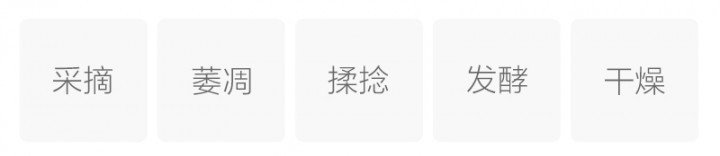
The inherited five-box outline shows picking, withering, rolling, oxidation and drying. It is a simplified black-tea map, not the complete refinements of each maker. The older 1955 naming account is distinguished from the independently read 2016/2020 local craft listings. No perpetual top-ten rank, exclusivity claim or single certified birthplace for every Zhejiang trade product is inferred.
Common questions
Does a Yuehong heritage listing certify my packet’s origin or grade?
No. The records concern a tea-making craft and its listed jurisdiction. The old source’s 2016 Zhuji entry is distinct from the 2020 Shaoxing listing. For a packet, check its actual maker, garden origin and specification; a cultural listing is not a product grade or tasting guarantee.
Can I move one number from this recipe into a different vessel?
Keep leaf form, measured dose and actual water, temperature, timing and separation together. Nominal capacity or a fill fraction is not a measured ratio.
Compare Keemun Gongfu, or browse the black tea overview.
Editorial notes and updates
Updated 16 October 2026. Valid original descriptions, sensory comparisons, prose and image methods, storage handling, China price figures and usable pictures are retained with their scope. Doubtful medical, ranking and exact historical claims are revised or omitted. Current full grade clauses and historical prices are not certified. Original Chinese-labelled graphics have English reading notes; no TeaPlain tasting or brewing test is claimed. Internal research and image audits record the decisions.