At a glance
This entry describes a chicory-and-gardenia herbal blend, not plain roasted chicory root coffee. Read the full ingredients; uric-acid tea is a marketing claim, not evidence that a bag treats gout.
| Detail | What to know |
|---|---|
| Chinese name | 菊苣茶(菊苣栀子茶) |
| Browsing group | Herbal infusion |
| Associated origin | Fengning, Chengde, Hebei is the inherited processing association |
| Material form | A labelled chicory, gardenia and other plant-material blend |
Taste and appearance
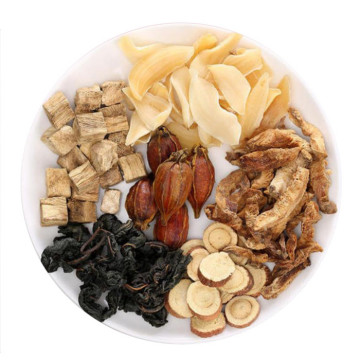
The original describes a blend with chicory, gardenia, mulberry leaf, kudzu root and lily material. Its table records large full compact pieces, reddish-yellow gardenia and yellow-grey chicory, a bright yellow cup, fresh fragrance and a refreshing slightly astringent or bitter sweet-returning taste. The original blend and cup pictures remain contextual, not a complete ingredient identification or same-lot test.
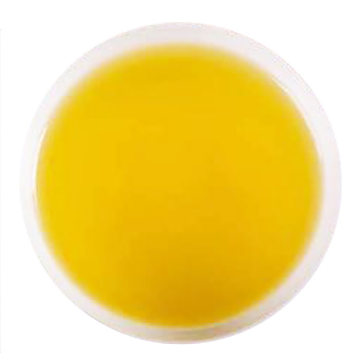
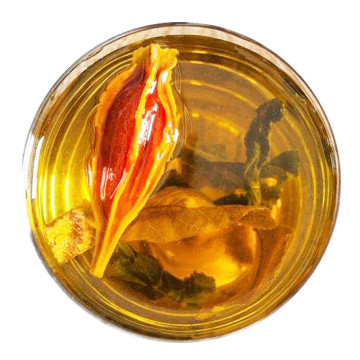
The cover is the original material illustration. These images are not TeaPlain tasting samples or proof of origin, grade, age, authenticity or image rights clearance.
Grade characteristics
This preserves the earlier Chinese edition’s sensory comparison. It is not a complete verified current standard table and does not grade your packet. Plant material, growing area, processing and grade are separate details. Decorative star rankings are omitted.
On a small screen, scroll the table sideways to compare the grades.
| Feature | Extra grade (old comparison) | Grade 1 (old comparison) | Grade 2 (old comparison) |
|---|---|---|---|
| Shape | Full compact even large pieces | Full compact even large pieces | Full compact fairly even pieces |
| Dry colour | Reddish-yellow gardenia and yellow-grey chicory | Reddish-yellow gardenia and yellow-grey chicory | Reddish-yellow gardenia and grey-white chicory |
| Liquor | Bright yellow | Bright yellow | Bright yellow |
| Aroma | Rich fresh fragrance | Rich fresh fragrance | Lasting fresh fragrance |
| Taste | Refreshing slightly astringent cup with sweet return | Refreshing slightly bitter cup | Refreshing slightly bitter cup |
| Spent material | Lively even pieces | Lively even pieces | Even pieces |
The old comparisons are retained without star ratings. They are not a complete verified current standard, a botanical identification key or an authentication of the pictured lot.
Names and origin
The old source associates processing with Fengning and describes roasted/blended material; this is not a universal growing origin for all ingredients. A medicinal assessment of Cichorium intybus root covers specific root preparations and explicitly excludes combinations from its summary. It cannot establish this blend’s ingredient amounts, preparation or gout benefit. A separately published official inspection also names a commercial chicory/gardenia substitute-tea product, supporting that this is a real blend category rather than synonymous with single-ingredient root coffee; one named inspected batch is not evidence that all blends share its quality.
Everyday benefits
No clinical result is established for this exact formula lowering uric acid or treating gout, liver disease, swelling or ulcers. Traditional evidence for a particular chicory-root preparation does not transfer to a gardenia/mulberry/kudzu/lily blend.
Who may enjoy this tea
For people who enjoy a suitable labelled mixed herbal drink after checking every ingredient. It is not a gout, uric-acid, liver, swelling or sore-throat treatment.
When to take care
Check all ingredients and medicines with a pharmacist if relevant; a multi-ingredient drink cannot inherit one ingredient’s suitability automatically. If receiving gout or other medical care, do not change treatment because a bag is labelled uric-acid tea. If taking medicines or Iron supplements, follow their instructions and ask a pharmacist about the actual product rather than assume that all herbal drinks have the same interactions. Pregnancy, breastfeeding, allergies and suitability for children need the identified ingredients and preparation; this page gives no medicinal dose.
How to brew
Original prose: glass or porcelain cup
The inherited method uses a heat-safe glass or porcelain cup, 1:50, 90–100°C / 194–212°F water, refilling at about one-third remaining and roughly three infusions. It gives no first steeping time. For an identified food-grade product only, an arithmetic example is 3 g with 150 mL Actual water; that is not a dose validated for every herb. Follow the complete packet instructions first. Different plant species, plant parts and processing cannot share one universal recipe.
These inherited directions are awaiting hands-on testing. Refilling changes the concentration and is not a new measured batch. Let the drink cool enough to sip; do not use a photograph to identify unknown plants.
Read the original illustration separately
Illustration: bagged blend. Add a bag, 300–500 mL Actual water above 95°C, steep 3–5 minutes, optionally add honey/sugar; the tips separately say 95–100°C / 203–212°F and refill at one-third. Bag mass is missing, so no fixed dose ratio follows. Keep this separate from the old loose-material 1:50 prose; adding sweeteners changes the drink.
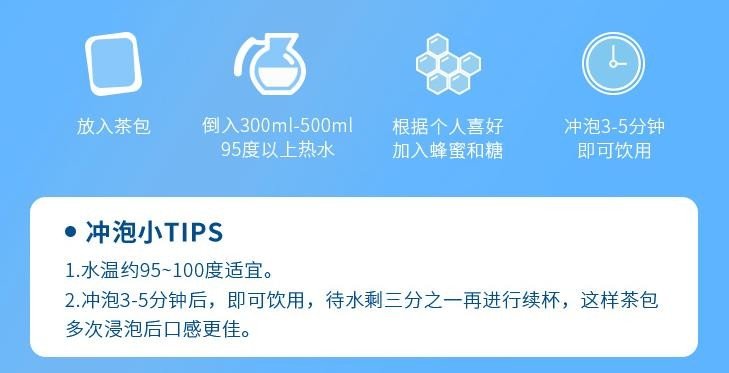
For ordinary teaware options, see brew without a gaiwan. Keep each complete method together instead of selecting temperature, dose and time from different preparations.
Adjust your cup
Identify the ingredients and follow the actual food product’s complete preparation instructions first. Once that is clear, adjust within those directions for taste. Do not increase the dose or boiling time of unknown plant material to make it suitable for drinking.
How to buy
Check the full ingredient list and parts, bag mass, actual source/maker, intended food category, dates and complete preparation. Plain chicory root, a root extract and this gardenia blend are different products.
See buy your first Chinese tea for packet comparisons.
China price reference
Undated figures retained from the Chinese edition, in Chinese yuan (CNY). No original brand, batch, harvest or quotation date was recorded. These are not verified current retail quotes, a market average or manufacturer-suggested retail prices.
| Chinese-edition tier | CNY per 500 g (one jin) | Equivalent CNY per 100 g |
|---|---|---|
| Extra grade | 500 | 100 |
| Grade 1 | 300 | 60 |
Per 100 g is an arithmetic conversion, not a quoted packet. Do not infer a missing sensory or price tier. Compare actual growing area, style, harvest, roast, weight and channel. A currency conversion does not make a UK or US retail offer comparable to a China historical figure.
How to store
Original storage method
After taking a portion, gently remove excess air from a suitable food-safe bag and close it tightly. Check the closure and bag for leaks; multiple layers do not repair a failed seal. Store cool and dry, protected from light, damp, kitchen steam and odours. Follow the actual packet dates; no shelf life or prepared-drink holding time is invented.
Origin, processing and history
The inherited map labels selection, drying, screening and packaging. It omits the actual identities, amounts and every ingredient’s processing; it does not certify a formula or a clinical result. Do not treat a generic blend chart as the preparation of plain chicory-root coffee.

Common questions
Is chicory/gardenia tea a proven gout treatment?
No treatment result is established for this blend here. Do not stop urate-lowering treatment or use a marketing name to choose a dose. The ingredients and product category need checking separately.
Can I move one number from this recipe into a different vessel?
Keep leaf form, measured dose and actual water, temperature, timing and separation together. Nominal capacity or a fill fraction is not a measured ratio.
Compare Winter Melon Lotus Leaf Tea, or browse the herbal infusion overview.
Editorial notes and updates
Updated 16 October 2026. Valid original descriptions, sensory comparisons, prose and image methods, storage handling, China price figures and usable pictures are retained with their scope. Doubtful medical, ranking and exact historical claims are revised or omitted. Current full grade clauses and historical prices are not certified. Original Chinese-labelled graphics have English reading notes; no TeaPlain tasting or brewing test is claimed. Internal research and image audits record the decisions.